Industrial Burner Actuators | Precision Control for Combustion Systems | Stiefel

+86 13928884373

Video Contact Us

All Categories

Precision Control with Industrial Burner Actuators for Optimal Combustion

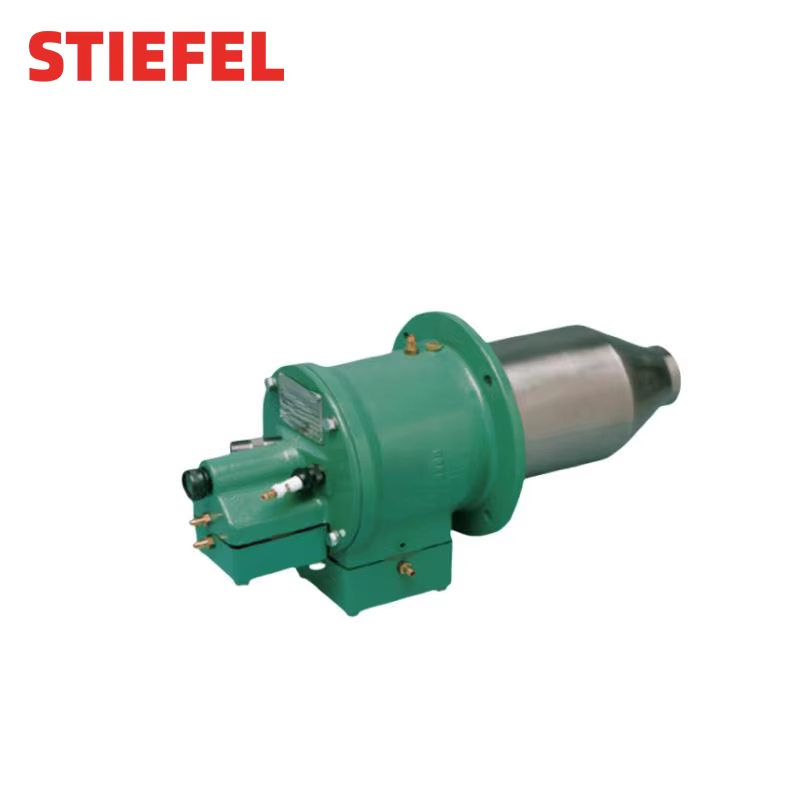
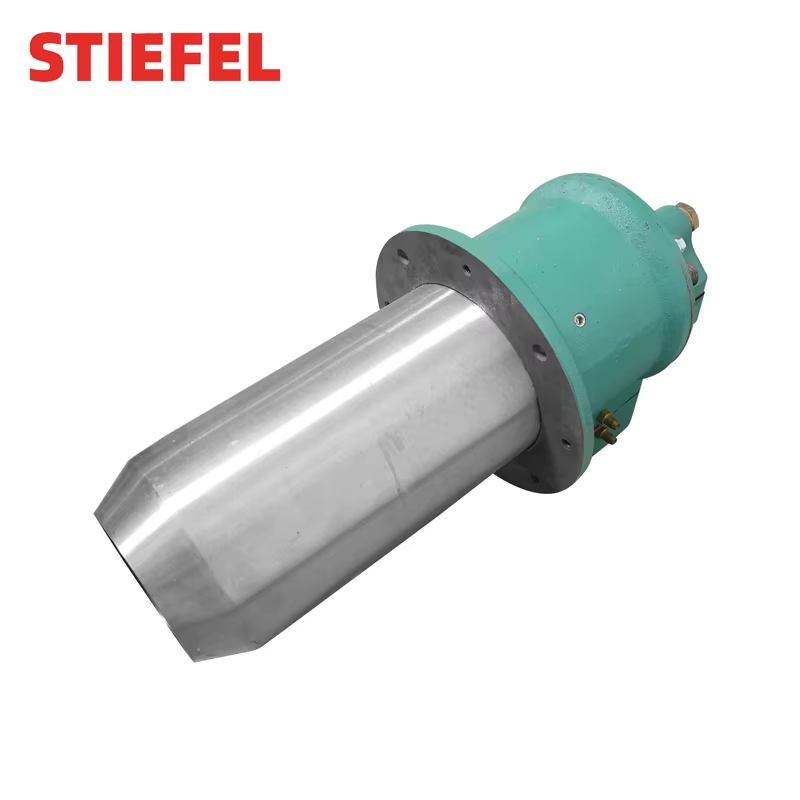
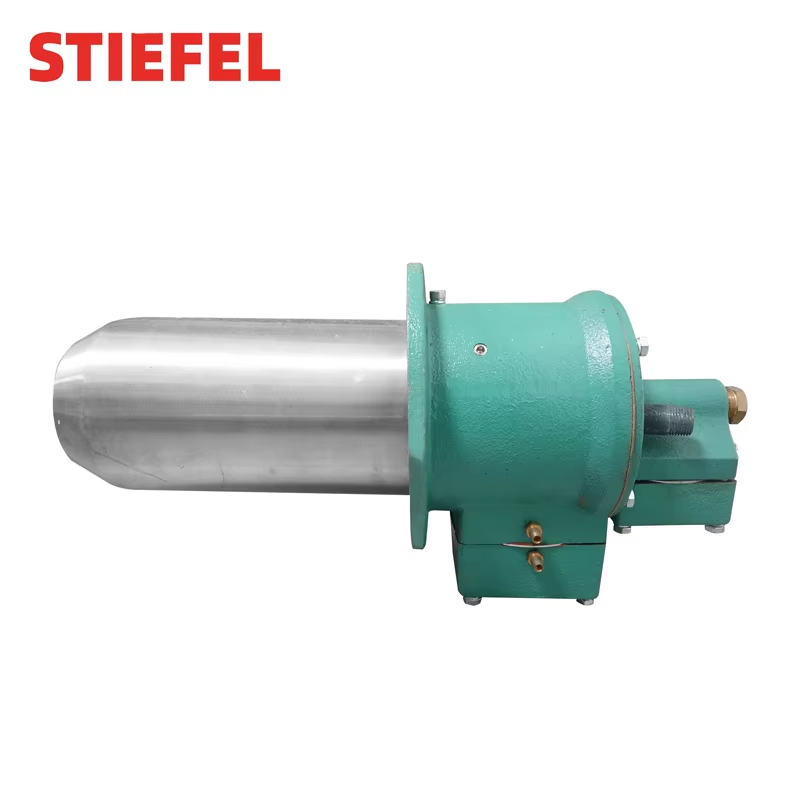
At Stiefel Combustion, we provide essential Industrial Burner Actuators that deliver precise and reliable control for modern combustion systems. As a trusted supplier since 2013, we are dedicated to enhancing the performance and efficiency of Industrial Burner operations. Our Industrial Burner Actuators are electromechanical or pneumatic devices designed to accurately position air dampers, gas valves, or other regulatory mechanisms based on signals from a burner management controller. This precise control is fundamental for maintaining the correct air-to-fuel ratio, ensuring efficient combustion, optimal heat output, and compliance with emission standards. These components are critical in applications ranging from large industrial boilers and process heaters to thermal oxidizers, where consistent and responsive modulation is required.
Get A Quote

Advantages of the product

Uncompromising Precision for Optimal Air-Fuel Ratio & Efficiency

Our Industrial Burner Actuators are engineered for exceptional positional accuracy and repeatability. This precision ensures that air dampers and fuel valves are adjusted to the exact opening required by the Industrial Burner controller. Maintaining this precise air-to-fuel ratio is the cornerstone of efficient combustion, minimizing unburned fuel and excess oxygen in the flue gas. The result is direct fuel savings, maximized thermal output from your Industrial Burner, and lower emissions. A high-performance Industrial Burner Actuator from Stiefel translates into tighter process control and tangible reductions in your energy operating costs.

Robust Construction for Demanding, High-Cycle Industrial Duty

We understand that Industrial Burner environments are demanding, with exposure to vibration, temperature fluctuations, and continuous modulation cycles. Our Industrial Burner Actuators are built with this harsh reality in mind. Featuring durable motors, hardened gear sets, and sturdy housings, they are designed to perform reliably over thousands of cycles without failure. This robust construction minimizes unexpected downtime, reduces maintenance needs, and ensures the long-term safety and reliability of your entire Industrial Burner system. Choosing a Stiefel Industrial Burner Actuator means investing in a component that will withstand the test of time and rigorous daily operation.

Related products

In the automated world of industrial heating, achieving precise and efficient combustion is a complex balancing act, critically dependent on the reliable operation of final control elements. Industrial Burner Actuators serve as these indispensable final control elements, physically converting electronic control signals into precise mechanical movement to regulate the flow of air and fuel into an Industrial Burner. At Stiefel Combustion, our expertise lies in supplying these vital components that bridge the gap between the burner management system’s commands and the physical process of combustion. An Industrial Burner Actuator is typically mounted on an air damper, a gas butterfly valve, or a linkage system and is responsible for accurately positioning these devices to control volumetric flow rates. The core objective of an Industrial Burner Actuator is to maintain the stoichiometrically optimal air-to-fuel ratio across various firing rates, a requirement essential for safety, efficiency, and environmental compliance in any Industrial Burner application.

The operational principle of an Industrial Burner Actuator involves receiving a control signal, most commonly a 4-20 mA analog signal or a 0-10 VDC signal, from a programmable logic controller (PLC) or a dedicated burner controller. This signal corresponds to a desired position, from fully closed to fully open. The actuator’s internal mechanism, whether electric or pneumatic, then drives its output shaft to the exact angular or linear position commanded. For example, in a modulating Industrial Burner system for a steam boiler, the actuator on the air damper continuously adjusts the combustion air intake in response to changing steam demand, ensuring the burner fires at just the right rate. Simultaneously, a linked or separately controlled Industrial Burner Actuator on the fuel valve coordinates to proportionally meter the gas or oil flow. This synchronized action, driven by responsive Industrial Burner Actuators, is what allows modern burners to operate efficiently at turndown ratios far exceeding older, on/off systems, leading to significant energy conservation.

Selecting the appropriate Industrial Burner Actuator requires careful consideration of several technical parameters to ensure compatibility and performance. Key specifications include the torque output (for rotary valves/dampers) or thrust force (for linear valves), the required rotational range (e.g., 90° or 180°), the control signal type, the operating voltage, and the speed of operation. The actuator must generate sufficient torque to overcome the resistance of the damper or valve under all operating conditions, including potential buildup or wear. The environmental rating is also crucial; actuators installed near an Industrial Burner must often be rated for high ambient temperatures or hazardous areas. Furthermore, features like manual overrides, positional feedback signals (4-20 mA or potentiometer), and fail-safe modes (spring-return to a safe position on power loss) are critical for safety and operational flexibility. An undersized or poorly specified Industrial Burner Actuator can lead to sluggish control, inaccurate positioning, premature failure, and ultimately, inefficient or unsafe burner operation.

The practical benefits of integrating high-quality, properly specified Industrial Burner Actuators are substantial across various industries. In a large process heater at a refinery, precise actuator control ensures stable temperatures for critical chemical reactions, directly impacting product quality and yield. In a textile plant’s thermal oil heater, modulating Industrial Burner Actuators allow for fine-tuned temperature control of the oil, improving fabric treatment consistency while saving fuel. Beyond efficiency and control, these actuators are fundamental to safety interlocks, ensuring fast and reliable closure of fuel valves on a safety shutdown command from the Industrial Burner controller. For facility managers and engineers, understanding the pivotal role of the Industrial Burner Actuator is key to optimizing system performance. To identify the ideal Industrial Burner Actuator for your specific valve type, damper size, and control architecture, we encourage you to contact Stiefel Combustion with your application details. Our team can provide expert guidance and a tailored quotation to ensure your Industrial Burner system achieves its full potential in efficiency, safety, and reliability.

Frequently Asked Questions

What are the key specifications to consider when replacing an Industrial Burner Actuator?

When selecting a replacement Industrial Burner Actuator, several critical specifications must match your existing system. The primary factors are the torque output (expressed in Nm or lb-in), the control signal type (e.g., 4-20 mA, 0-10 VDC, or three-point control), the operating voltage (e.g., 24V AC/DC, 110V AC, 230V AC), and the rotational range (typically 90° or 180°). You must also verify the mounting interface pattern and shaft size to ensure it fits your existing damper or valve. Additionally, consider any required features like an mechanical position indicator, a manual handwheel override, or a feedback signal. Providing these details to our Stiefel technical team will ensure we recommend a compatible and high-performance Industrial Burner Actuator for your Industrial Burner.
Yes, many of our Industrial Burner Actuators are available with integrated positional feedback mechanisms. This is a crucial feature for advanced burner control systems. The most common feedback options are a potentiometer (providing a resistance value proportional to position) or a 4-20 mA analog signal transmitter. This feedback signal is sent back to the Industrial Burner controller, allowing it to verify that the actuator has moved to the commanded position (closed-loop control). This ensures accurate modulation, enhances system safety by confirming valve/damper status, and can help in diagnosing control issues. Please specify your feedback requirement when inquiring about our Industrial Burner Actuator solutions.

Related Articles

Oil Burners: Efficient Heating Solutions​

22

Apr

Oil Burners: Efficient Heating Solutions​

Businesses and houses nowadays have a requirement for some form of heating. Oil burners are one of the most trusted and used methods for heating during the colder months. This article further explains oil burners aspects, understanding their advantag...
View More
Gas Solenoid Valves: Precision Control at Your Fingertips​

22

Apr

Gas Solenoid Valves: Precision Control at Your Fingertips​

The functionality and precision of gas solenoid valves have made them popular in modern automation and control systems. For industrial tools as well as household devices, valves are important for controlling gas flow. This article covers the most i...
View More
Our Solenoid Valves: Your Ideal Choice

22

Apr

Our Solenoid Valves: Your Ideal Choice

In the world of industrial automation, these devices are seen as simple, yet function well within the environment that uses them. These valves, which are used in different industries, control the flow of liquid and gas. This article focuses on the be...
View More
Why Our Gas Burners are Industry – Leading​

22

Apr

Why Our Gas Burners are Industry – Leading​

In the race of cooking equipment, gas burners come out on top among professionals and home chefs. These pieces of gas cooking tools undergo engineering to ensure performance, efficiency and safety unlike any other. This article will cover technology,...
View More

Customer Reviews

Hans M.

"Our package boilers were struggling with slow response to steam demand changes, causing pressure swings. We replaced the old, sluggish actuators on the air and gas valves with Stiefel's Industrial Burner Actuators. The improvement was immediate. The modulation is now smooth and precise, allowing our Industrial Burner controllers to maintain a perfect air-fuel ratio. Boiler pressure is now stable, and our fuel efficiency has noticeably improved. The build quality and reliability of these Industrial Burner Actuators are excellent."

Jacob

"We operate a process heater in a harsh environment with high ambient heat. The previous actuators failed frequently. After switching to the rugged Industrial Burner Actuators from Stiefel, our downtime has been eliminated. They handle the continuous modulation and high temperature without issue. The positional accuracy keeps our process temperature tightly controlled, which is vital for product quality. These are dependable actuators built for real Industrial Burner challenges."

Get a Free Quote

Our representative will contact you soon.
Email
Mobile/Whatsapp
Name
Company Name
Message
0/1000
Precision for Peak Combustion Efficiency

Precision for Peak Combustion Efficiency

Our Industrial Burner Actuators deliver the exact positional control needed to maintain optimal air-fuel ratios. This precision is the key to unlocking maximum fuel efficiency and clean combustion from your Industrial Burner.
Engineered for Industrial Durability

Engineered for Industrial Durability

Built to endure the vibration, heat, and continuous cycling of industrial environments, our Industrial Burner Actuators are designed for long-term, reliable service, minimizing maintenance and protecting your combustion system's uptime.
Your Partner in Burner Control Upgrades

Your Partner in Burner Control Upgrades

Enhancing your system's control starts with the right component. Contact Stiefel today for expert support in selecting the perfect Industrial Burner Actuator to improve your system's performance, safety, and economy.