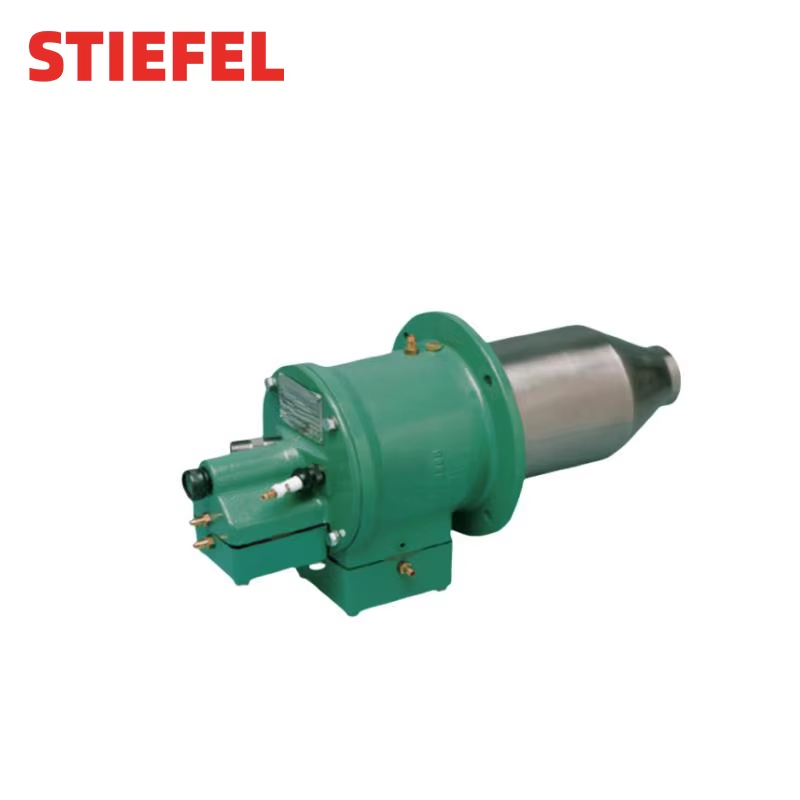
The imperative for Low NOx Gas Burner systems stems from environmental regulations and a fundamental understanding of combustion chemistry. Nitrogen Oxides (NOx), primarily nitric oxide (NO) and nitrogen dioxide (NO₂), are formed during the combustion of fossil fuels when nitrogen from the air (atmospheric N₂) or from the fuel itself (fuel-bound nitrogen) reacts with oxygen at high temperatures. The primary formation mechanism, known as thermal NOx, is exponentially dependent on flame temperature; even a small reduction in peak temperature can lead to a dramatic decrease in NOx production. A modern Low NOx Gas Burner is specifically engineered to manipulate the combustion environment to minimize these temperatures and disrupt NOx formation pathways, achieving emissions often below 30-60 mg/Nm³ (at 3% O₂), depending on the specific technology and design. This is a substantial reduction compared to conventional burners, which may emit 80-150 mg/Nm³ or more. Investing in a Low NOx Gas Burner is therefore not merely an environmental consideration but a strategic business decision to ensure regulatory compliance, avoid potential fines, and future-proof industrial operations against tightening global emission standards.
The engineering of an effective Low NOx Gas Burner revolves around several key principles. One of the most common and robust techniques is staged combustion. In a staged Low NOx Gas Burner, the total combustion air is divided. A sub-stoichiometric amount of air is mixed with the fuel in the primary zone, creating a fuel-rich, oxygen-lean environment where the flame temperature is lower, and chemical pathways favor the conversion of fuel-bound nitrogen to molecular nitrogen (N₂) rather than NOx. The remaining "overfire" air is then introduced in a secondary zone downstream to complete the combustion. This two-stage process creates a longer, more distributed flame with a cooler temperature profile. Another advanced method is Flue Gas Recirculation (FGR), often integrated into the Low NOx Gas Burner itself. In this design, a portion of the cooler exhaust gases (flue gases) is internally recirculated back into the burner's primary combustion zone. These inert gases absorb heat, dilute the oxygen concentration, and significantly lower the peak flame temperature. A Low NOx Gas Burner utilizing FGR can achieve very low emission levels. Crucially, all these techniques must be coupled with precision air-fuel ratio control. An advanced Low NOx Gas Burner system employs high-quality actuators, linkage systems, and a programmable logic controller (PLC) to maintain the exact air-fuel ratio across the entire turndown range, ensuring low emissions and high efficiency at both high and low fire conditions.
The application of a Low NOx Gas Burner is critical across numerous sectors. In commercial and institutional heating, such as university campuses or hospital complexes with central boiler plants, installing a Low NOx Gas Burner is often mandated by local air quality districts to reduce the facility's contribution to ground-level ozone and smog. Retrofitting an older boiler with a new Low NOx Gas Burner allows these institutions to meet compliance deadlines without the massive capital expense of a complete boiler replacement. In industrial manufacturing, for example, a food processing plant using thermal fluid heaters for cooking oil, a Low NOx Gas Burner upgrade can be part of a sustainability initiative that also improves process consistency and reduces fuel costs. Similarly, in metal processing facilities with annealing furnaces, a Low NOx Gas Burner provides the precise, clean, and controllable heat necessary for consistent product quality while ensuring the plant operates within its environmental permit. To determine the most suitable Low NOx Gas Burner technology for your specific application, obtain detailed technical specifications, and receive a customized quotation based on your thermal capacity and emission targets, please contact our engineering team directly. We can assess your current system and recommend the optimal Low NOx Gas Burner solution.
 EN
EN